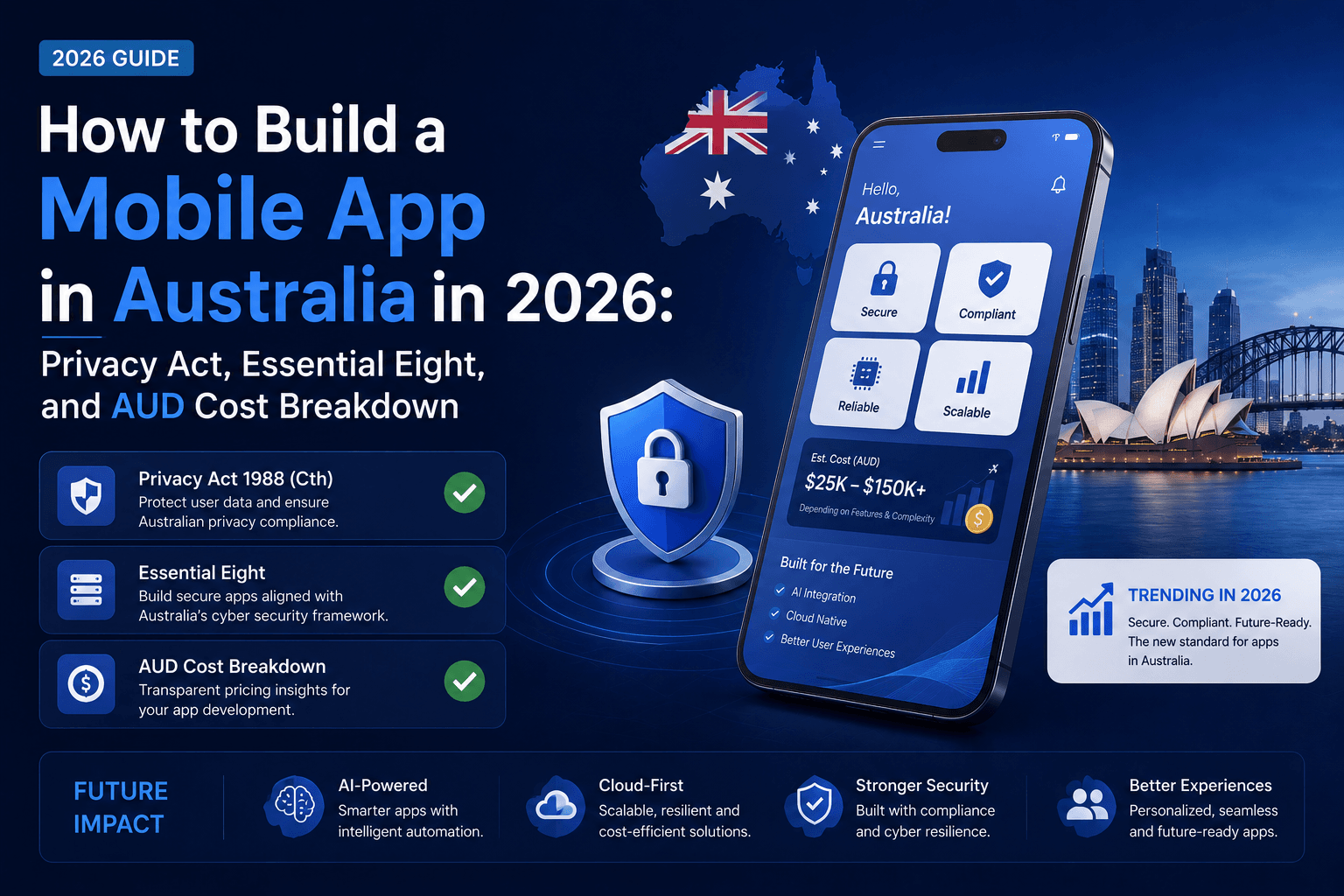
Sydney startups in 2026 are no longer building apps just to enter the market. They are building AI powered, scalable digital products that help them validate ideas faster and compete globally. Australia's mobile economy is projected to generate over four billion AUD in application revenue this year. Within that ecosystem Sydney operates as the undisputed capital of venture backed innovation.
This guide is structured as a complete decision making resource for founders seeking custom mobile apps for startups. It covers the local startup ecosystem, why Sydney businesses are investing in mobile first products, realistic cost modelling in Australian dollars, a practical development roadmap, technology comparisons, Australian privacy requirements, and lessons drawn from real local ventures.
Overview of Sydney's Startup Ecosystem
Sydney is home to over forty percent of Australia's venture capital activity. The city's startup infrastructure has matured significantly since the establishment of the Tech Central innovation district anchored around Central Station. Government backed programs like the NSW Startup Hub and LaunchPad provide co working spaces, mentorship, and grant funding specifically designed for early stage technology companies headquartered in Sydney.
Several structural advantages define why Sydney attracts founders building mobile products:
- Proximity to Asia Pacific Markets: Applications launched from Sydney can scale into Southeast Asian markets with minimal architectural changes due to shared timezone advantages and regional cloud infrastructure hosted locally in the AWS Sydney availability zone.
- Skilled Talent Pool: Sydney's universities graduate thousands of computer science and engineering students annually. The University of Sydney and UNSW consistently rank among the global top fifty for technology disciplines, creating a steady pipeline of local engineering talent.
- Investor Density: Sydney based firms like Blackbird Ventures, Square Peg Capital, and AirTree Ventures have collectively deployed billions into Australian startups, with mobile first companies representing a growing share of their portfolios.
- Government Support: The New South Wales government actively incentivises digital innovation through R&D tax offsets, the Sydney Startup Hub co working program, and targeted grants for technology companies operating within the state.
Why Sydney Startups Need Mobile Apps in 2026
The shift toward mobile first products among Sydney startups has accelerated dramatically. Industry data indicates that over seventy percent of new venture backed Australian companies now prioritise mobile applications as their primary customer interface rather than desktop websites.
Several factors are driving this transformation across Sydney:
- Consumer Behaviour: Australian smartphone users spend an average of four hours daily on mobile applications, creating massive addressable markets for well designed products launched from Sydney.
- Government Digitisation: Federal and New South Wales state government services are increasingly delivered through mobile channels, normalising app based interactions across all demographics in the Sydney metropolitan area.
- Remote Work Infrastructure: The permanent shift toward hybrid work models across Sydney's corporate sector has created sustained demand for mobile productivity, collaboration, and field service management tools.
- 5G Rollout in Sydney: The expansion of 5G networks across Sydney and surrounding regional New South Wales enables applications with richer media, real time data processing, and more sophisticated user experiences for local consumers.
- Competitive Pressure: Sydney startups competing for the same customer base are rapidly discovering that companies without mobile applications lose market share to competitors who provide convenient mobile access to their services.
Fast-growing industries in Sydney adopting mobile apps
Not all mobile applications carry equal market potential in the Australian landscape. The following industries represent the strongest product market fit for Sydney based founders in 2026.
FinTech
Australia's Open Banking regime administered by the Australian Competition and Consumer Commission has created massive demand for applications that help Sydney consumers manage, compare, and switch financial products. The New Payments Platform enables real time settlement making peer to peer lending and micro investment platforms viable at scale. Sydney FinTech startups are increasingly deploying AI powered features such as predictive analytics for investment recommendations, AI chatbots for automated customer support, and real time fraud detection engines that analyse transaction patterns to flag suspicious activity. Sydney app developers for startups in this sector must architect data handling around the Consumer Data Right from day one.
Healthcare
The Australian Digital Health Agency is accelerating adoption of electronic health records through the My Health Record system. Mobile applications serving Sydney's healthcare sector are integrating AI driven capabilities including symptom assessment chatbots that triage patients before appointments, recommendation engines that suggest personalised treatment plans based on medical history, and workflow automation tools that reduce administrative burden on clinicians by automating appointment scheduling, prescription renewals, and referral processing. These applications must comply with the Australian Privacy Principles and implement biometric device enclaves to process sensitive medical telemetry without transmitting it over public networks. Telehealth platforms serving patients across New South Wales have seen sustained demand since the permanent Medicare rebate changes.
Retail
Australia's retail sector generates over three hundred billion AUD annually with mobile commerce accounting for an increasingly dominant share among Sydney consumers. Successful retail applications in the Sydney market now leverage AI recommendation engines that personalise product suggestions based on browsing history and purchase patterns, increasing average order values by fifteen to thirty percent. Predictive analytics tools forecast inventory demand across Sydney distribution centres while AI chatbots handle routine customer enquiries, freeing human support agents for complex issues. Founders building in this space must integrate with local payment processors and Australian logistics networks. Applications that deliver sub three second load times and support offline browsing gain measurable conversion advantages in the Sydney market.
SaaS Platforms
Enterprise SaaS companies headquartered in Sydney are rapidly transitioning from desktop portals to mobile first interfaces. Field service management, workforce scheduling, and compliance reporting tools are among the highest demand categories. AI app development Australia trends are driving SaaS platforms to embed workflow automation that eliminates repetitive manual tasks, predictive analytics dashboards that surface actionable business insights, and intelligent notification systems that prioritise alerts based on urgency and user role. These applications require robust offline synchronisation capabilities and strict role based access controls to serve distributed Australian workforces operating across vast geographic distances from Sydney offices.
Real Estate
Sydney's property market is one of the most active and competitive in the world. Mobile applications offering virtual property inspections, augmented reality floor plan visualisation, real time auction bidding, and neighbourhood analytics are capturing significant market share among Sydney buyers and investors. PropTech startups building for the Sydney market must integrate with local listing platforms and comply with New South Wales fair trading regulations governing property transactions.
On Demand Services
The on demand economy in Sydney continues to expand beyond ride sharing and food delivery into sectors like healthcare appointments, home maintenance, legal consultations, and pet care. Applications in this category require sophisticated real time geolocation tracking, dynamic pricing algorithms powered by predictive analytics, and seamless payment integration. AI chatbots handle booking modifications and customer enquiries around the clock, reducing operational costs for Sydney based on demand startups. Founders building on demand platforms in Sydney benefit from the city's dense urban population and established consumer comfort with app based service booking.
Logistics and Supply Chain
Sydney serves as a major logistics hub connecting Australian domestic supply chains with international shipping routes through Port Botany and Sydney Airport. Mobile applications serving this sector enable real time fleet tracking, automated route optimisation using AI algorithms, warehouse inventory management, and digital proof of delivery workflows. Predictive analytics tools forecast delivery volumes and identify potential supply chain disruptions before they impact operations. Sydney logistics startups building mobile platforms must integrate with Australian customs systems and comply with chain of custody documentation requirements for regulated goods.
Australian Privacy and Data Protection Requirements
Building a mobile application that processes Australian user data triggers a specific set of legal obligations that Sydney founders should understand before writing any code. Working with one of the top mobile app development companies in Sydney can also help address compliance and security considerations during the initial development process.
| Compliance Framework | Requirement Level | Application Area |
|---|---|---|
| Australian Privacy Principles | Mandatory | All apps collecting personal data |
| Notifiable Data Breaches Scheme | Mandatory | All apps processing personally identifiable information |
| Consumer Data Right | Mandatory for regulated sectors | FinTech and energy applications |
| Essential Eight Maturity Model | Highly Recommended | Core backend infrastructure |
| Multi Factor Authentication | Required | All user facing authentication flows |
| Local Data Hosting | Often Required | Financial and health data |
The Notifiable Data Breaches scheme requires organisations to notify the Office of the Australian Information Commissioner and affected individuals when a data breach is likely to result in serious harm. Non compliance carries financial penalties that can reach millions of AUD. Integrating breach detection and notification workflows into your architecture from the earliest MVP development stage is far less expensive than retrofitting them after launch.
Mobile Security Expectations
Australian consumers hold exceptionally high expectations regarding the security of mobile applications, particularly those handling financial or health data. Sydney founders must implement the following security measures as baseline requirements rather than optional additions:
- Certificate Pinning: Prevents man in the middle attacks by validating server certificates directly within the application code.
- Biometric Authentication: Over eighty percent of Sydney users now prefer fingerprint or facial recognition over traditional passwords for sensitive applications.
- Encrypted Local Storage: All personally identifiable information stored on the device must be encrypted at rest using AES 256 or equivalent standards.
- Jailbreak and Root Detection: Applications processing financial data should detect compromised devices and restrict functionality accordingly.
- Secure API Communication: All data transmitted between the application and backend servers must use TLS 1.3 encryption as a minimum standard.
Compliance Considerations for Finance and Healthcare
FinTech applications operating in the Sydney market face additional scrutiny from ASIC and the Australian Prudential Regulation Authority. These applications must implement transaction monitoring, anti money laundering checks, and real time fraud detection systems. HealthTech applications must comply with the Australian Privacy Principles specifically regarding the handling of health information, which carries stricter protections than general personal data under Australian law.
Local Market Trends and User Behaviour
Understanding how Sydney consumers interact with mobile applications is critical for product design decisions:
- Privacy Sensitivity: Australian consumers rank among the most privacy conscious globally. Applications that clearly communicate how data is collected, stored, and used achieve measurably higher trust scores and retention rates in the Sydney market.
- Speed Expectations: Analytics indicate that Sydney consumers abandon applications if initial load times exceed three seconds, regardless of cellular connection quality.
- Offline Expectations: Users commuting through Sydney's underground rail network or travelling to regional New South Wales expect applications to function seamlessly during periods without connectivity.
- Local Payment Preference: Sydney consumers strongly prefer applications that support local payment methods and display pricing in Australian dollars without currency conversion surprises.
How Much Does It Cost to Build a Mobile App in Sydney in 2026
Cost is consistently the first question Sydney startup founders research. Understanding the factors that affect pricing, including features, complexity, design requirements, backend architecture, and maintenance, helps founders plan their investment before selecting a development partner. The figures below reflect actual market rates for Sydney based and Australia serving development teams in 2026.
Development Cost by Complexity
| Application Type | Estimated Cost (AUD) | What You Get |
|---|---|---|
| Simple MVP | $45,000 to $85,000 | Core feature set, single platform, basic backend |
| Medium Complexity App | $90,000 to $180,000 | Multi platform, API integrations, user analytics |
| Enterprise Grade App | $200,000 to $500,000 plus | Custom software development, compliance layer, admin dashboards |
Development Timeline
| App Type | Timeline | Best For |
|---|---|---|
| MVP App | 2 to 4 months | Validating a startup idea |
| Medium Complexity App | 4 to 8 months | Growing businesses |
| Enterprise App | 8 plus months | Large scale platforms |
Cost transparency helps Sydney founders understand scope, budget, and expectations before selecting a development partner.
Granular Cost Breakdown by Development Phase
| Development Phase | Estimated Cost (AUD) | Notes |
|---|---|---|
| UI UX Design | $8,000 to $30,000 | Wireframes, prototypes, user testing |
| Backend and API Development | $20,000 to $80,000 | Server architecture, database design, third party integrations |
| Frontend Mobile Development | $25,000 to $100,000 | iOS and Android client applications |
| Quality Assurance and Testing | $5,000 to $25,000 | Manual testing, automated tests, penetration testing |
| Project Management | $5,000 to $20,000 | Coordination, milestone tracking, stakeholder communication |
Ongoing Costs After Launch
| Cost Category | Estimated Annual Cost (AUD) | Notes |
|---|---|---|
| App Maintenance and Support | 20% of initial build cost | Bug fixes, OS updates, security patches |
| Cloud Hosting (AWS Sydney) | $3,000 to $30,000 | Scales with user volume and data storage |
| Post Launch Updates and Features | $10,000 to $50,000 | New features based on user feedback and analytics |
| Apple Developer Account | $149 | Required for App Store distribution |
| Google Play Developer Account | $35 one time | Required for Play Store distribution |
| Third Party API Fees | $500 to $10,000 per month | Maps, payment gateways, analytics, messaging |
| SSL Certificates and Security | $200 to $2,000 | Mandatory for encrypted data transmission |
What Drives Cost Up for Sydney Startups
- Features: The sheer volume of functionality, particularly custom logic, directly impacts development hours.
- UI/UX complexity: Custom animations, bespoke transitions, and non standard navigation patterns require significantly more effort than native components.
- AI integration: Implementing on device machine learning or complex predictive analytics pipelines increases backend and architecture costs.
- Backend requirements: Applications needing real time synchronisation, offline support, or integration with legacy enterprise systems require extensive server side engineering.
- Security compliance: FinTech and HealthTech applications require specialised security audits, penetration testing, and adherence to the Notifiable Data Breaches scheme, increasing baseline costs.
Complete Startup App Development Roadmap
The following seven step roadmap reflects the actual process successful Sydney startups follow from idea validation through MVP development Sydney founders rely on, all the way to maintenance and scaling. MVP focused approaches are especially useful for startups because they allow founders to validate ideas before committing large budgets.
Step 1: Validate Your App Idea
Before committing any capital confirm that real demand exists in the Sydney market.
- Identify your target users: Define exactly who will use your application, their demographics, their pain points, and their willingness to pay for a solution.
- Research competitors: Analyse competing applications in the Australian App Store and Play Store. Document their feature sets, pricing models, user reviews, and rating trajectories over the past twelve months.
- Confirm market demand: Conduct user interviews with a minimum of fifteen to twenty potential customers in your target segment within Sydney. Build a simple landing page to capture email signups and measure conversion rates.
Step 2: Define Your MVP
Start with essential features to test your core idea before investing heavily.
- Select essential features: A focused MVP should contain no more than three to five core features that directly solve the primary user problem.
- Avoid unnecessary development costs: Resist the temptation to add secondary functionality at this stage. Every additional feature increases budget, timeline, and testing complexity.
- Test your core idea quickly: The purpose of an MVP is to validate market demand with real Sydney users at the lowest possible capital expenditure before committing to full scale development.
Step 3: Create UI and UX Design
Create user friendly designs that can be tested with real users before any development begins.
- Build wireframes: Map out every screen and user flow to establish the complete navigation structure of your application.
- Create prototypes: Commission professional UI UX design to produce interactive prototypes that simulate the real application experience.
- Improve user experience: Test prototypes with real Sydney users and iterate based on their feedback. Every additional tap required to complete a core action measurably increases abandonment rates among Australian consumers.
Step 4: Select the Right Technology
Choose the best development approach based on budget, timeline, and scalability requirements.
- Native development: Choose native iOS (Swift) and Android (Kotlin) when building applications that require maximum computational performance such as real time financial trading platforms for Sydney's FinTech sector or augmented reality property inspection tools for Sydney's real estate market.
- Flutter: Choose Flutter app development in Sydney when launching a cross platform MVP under budget constraints while requiring consistent visual design across iOS and Android. Flutter is the strongest choice for most Sydney startups optimising for speed and cost efficiency.
- React Native: Choose React Native development in Sydney when your existing engineering team has deep JavaScript or TypeScript expertise and you want to share code between mobile and web applications.
For startups requiring advanced capabilities explore AI application development integration and custom software development options.
Step 5: Develop and Test
Build the application and rigorously test across all critical dimensions.
- Performance: Engineer the backend infrastructure utilising AWS Sydney data centres for lowest possible latency to domestic users. Implement continuous integration and continuous deployment pipelines from the start.
- Security: Conduct penetration testing to identify vulnerabilities before any user data enters the system. Implement certificate pinning, encrypted storage, and biometric authentication.
- User experience: Test the complete user journey with real Sydney users to identify friction points and abandonment triggers.
- Device compatibility: Execute testing across physical iOS and Android devices under realistic Australian network conditions including fluctuating cellular connectivity in regional New South Wales.
Step 6: Launch and Market
Release the app and attract early users through a coordinated Sydney market launch strategy.
- Release the app: Optimise App Store and Play Store listing metadata specifically targeting Australian search terms such as "mobile app development Sydney" and related local queries.
- Collect user feedback: Engage early beta users to generate initial reviews and ratings. Monitor crash reports and user analytics intensively during the first seventy two hours after release.
- Improve based on analytics: Track feature adoption rates, session durations, and conversion funnels to identify what Sydney users actually value versus what you assumed they would want.
Step 7: Maintenance and Scaling
Use analytics and customer feedback to maintain and grow the product strategically.
- Ongoing maintenance: Budget for continuous app maintenance and support including bug fixes, security patches, and compatibility updates for new iOS and Android releases. Applications that skip maintenance become unstable within twelve to eighteen months.
- Add new features: Prioritise development of the features your Sydney user base actually engages with rather than building based on assumptions. Use predictive analytics to identify which features will drive the highest retention.
- Improve performance: Implement A/B testing for onboarding flows and conversion funnels. Optimise load times and reduce application size.
- Prepare for growth: Scale infrastructure proactively based on growth trajectory projections rather than reacting to outages after they occur.
Flutter vs Native vs React Native Comparison
Choosing the right technology stack is a strategic decision that impacts cost, timeline, and long term maintainability for Sydney startups. This section targets additional searches such as Flutter app development Sydney, React Native development Sydney, and native app development Sydney.
| Technology | Best For |
|---|---|
| Native iOS and Android Development | High performance applications requiring advanced device features |
| Flutter | Faster cross platform MVP development |
| React Native | Startups with existing JavaScript and React teams |
Detailed Comparison
| Factor | Native (Swift and Kotlin) | Flutter | React Native |
|---|---|---|---|
| Performance | Highest possible | Near native | Good |
| Development Speed | Slower (two separate codebases) | Fast (single codebase) | Fast (single codebase) |
| Cost | Higher (maintaining two teams) | Lower (one team both platforms) | Lower (one team both platforms) |
| Scalability | Excellent | Excellent | Good |
| UI Consistency | Platform specific design | Pixel perfect across platforms | Platform adaptive |
| Community and Ecosystem | Mature and extensive | Growing rapidly | Large and established |
| Offline Support | Full | Full | Full |
| Access to Device APIs | Complete | Most APIs supported | Most APIs supported |
Real Australian Startup Case Studies
Canva
Founded in Sydney, Canva grew from a simple design tool into a platform valued at over forty billion AUD. Their mobile application demonstrates that complex functionality can be delivered through intuitive interfaces. The lesson for Sydney founders is that investing heavily in UI UX design and removing friction from core workflows directly correlates with user retention and revenue growth.
Afterpay
This Sydney originated FinTech pioneered the buy now pay later model under intense regulatory scrutiny from ASIC and the Australian Prudential Regulation Authority. Their journey proves that building compliance into the technical architecture from day one is not optional in the Australian market. Retrofitting regulatory compliance after scaling is exponentially more expensive and can halt growth entirely.
Linktree
Linktree started as a lightweight tool solving one specific problem and scaled to millions of users globally from its Australian base. Their success demonstrates that a tightly scoped MVP focused on a single pain point can achieve massive traction faster than feature rich platforms that attempt to do everything at launch.
Common Development Challenges and Solutions
Startup founders generally look for proof that a development partner can deliver a successful product, not only technical information. Understanding where other Sydney founders have struggled is as valuable as studying their successes.
Building too many features in version one: The most successful Sydney startups launched with three to five core features. Start lean, validate with real Sydney users, then expand based on data.
Choosing a development partner based solely on price: The cheapest agency frequently lacks experience with Australian compliance frameworks. Rebuilding a non compliant application costs significantly more than paying a fair rate initially.
Skipping user research in the Sydney market: Founders who validate their concept with real Sydney based users before development consistently achieve higher retention rates and lower customer acquisition costs after launch.
Ignoring post launch maintenance: Applications require continuous updates to remain compatible with new iOS and Android releases. Sydney founders who do not budget for ongoing app maintenance and support discover their products become unstable within twelve to eighteen months.
Underestimating Australian compliance costs: FinTech and HealthTech applications in Australia require specialised security audits, penetration testing, and ongoing compliance monitoring.
Launching without analytics: Sydney founders who release applications without comprehensive event tracking lose the ability to make data driven decisions about which features to build next.
Building Trust and Credibility for Your Sydney App
For a product to succeed in the Sydney market it must establish immediate trust with local users. Australian consumers are highly sceptical of new applications, particularly those handling financial or personal data.
Strategies that build user confidence include:
- Publishing real app screenshots of your working interface across all marketing channels rather than using generic mockups
- Sharing genuine client success stories with measurable before and after results showing how user feedback directly shaped feature development
- Displaying direct links to your active App Store and Play Store listings so Sydney users can independently verify ratings and reviews
- Documenting specific startup challenges you faced and the solutions you implemented, demonstrating authentic experience
- Making founder backgrounds and team credentials transparently accessible on your website
- Earning and displaying independent verification through platforms like Clutch, GoodFirms, or The Manifest
- Collecting and publishing genuine customer testimonials from Sydney based clients
Why Choose a Sydney App Development Partner?
While offshore development initially appears cheaper on paper, engaging a local Sydney MVP development company often reduces the total cost of ownership over the product's lifecycle. Startup founders specifically benefit from:
- Better communication timezone wise: Real time collaboration during Australian business hours prevents the twenty four hour feedback loops that frequently stall offshore projects.
- Understanding of Australian users: Local app developers Sydney understand the nuances of the domestic market, from preferred local payment gateways to offline usage expectations during regional travel.
- Compliance knowledge: A Sydney partner inherently understands the Australian Privacy Principles, the Consumer Data Right, and the Notifiable Data Breaches scheme, ensuring compliance is architected from day one.
- Long term support: Local partners provide accountability and reliable ongoing app maintenance and support as your application scales and OS updates are released.
How to Choose a Mobile App Development Company in Sydney
Selecting the right development partner is one of the highest impact decisions a Sydney founder will make. Evaluate agencies based on demonstrated capability not marketing claims.
Evaluation Criteria
- Portfolio: Review completed projects in your specific industry vertical within the Australian market
- Technical expertise: Confirm capabilities across Flutter development, AI application development, and custom software development
- Industry experience: Verify experience with Australian regulatory requirements including the Notifiable Data Breaches scheme
- Communication process: Ensure transparent project management and milestone based billing
- Post launch support: Confirm clear maintenance agreements covering bug fixes, OS updates, and security patches
Questions to Ask Before Signing
- ho owns the intellectual property and source code upon project completion?
- an you provide references from Sydney or Australian clients in my specific industry?
- ow do you handle critical bug fixes after the application launches?
- o you conduct penetration testing and comply with the Notifiable Data Breaches scheme?
- hat is your process for handling scope changes during development?
- an you share before and after examples of products you have improved for existing clients?
Frequently Asked Questions
1. How much does it cost to build a mobile app in Sydney in 2026?
The cost depends on features, complexity, design requirements, backend architecture, and ongoing maintenance needs. A simple MVP typically costs between AUD 45,000 and AUD 85,000. Medium complexity applications with multiple integrations range from AUD 90,000 to AUD 180,000. Enterprise grade platforms with custom software development, compliance layers, and admin dashboards start at AUD 200,000 and can exceed AUD 500,000.
2. How long does MVP app development take?
An MVP app can typically be developed in two to four months. This timeline is ideal for validating a startup idea quickly. Medium complexity applications require four to eight months, while enterprise platforms take eight or more months from discovery to launch.
3. Should startups build iOS or Android first in Australia?
For the Australian market, launching on iOS first is historically recommended if budget constraints prevent simultaneous development, as iOS commands slightly more than fifty percent of the domestic market share and typically generates higher average revenue per user. However, using cross platform frameworks like Flutter eliminates this decision by allowing simultaneous deployment to both platforms.
4. Should Sydney startups choose Flutter or native apps?
The choice depends on your specific requirements. Flutter app development offers faster development speed and lower cost because it enables cross platform deployment from a single codebase. It provides near native performance, making it the strongest choice for startups optimising for speed and cost efficiency. Native apps (Swift and Kotlin) are preferable only when building applications that require maximum computational performance, such as financial trading platforms.
5. How do I choose a mobile app development company in Sydney?
Evaluate potential partners based on their portfolio of completed projects in your industry, their technical expertise across relevant frameworks, their experience with Australian compliance requirements, their communication process and project management approach, and their post launch support capabilities. Request references from existing Sydney or Australian clients and avoid selecting based solely on the lowest quoted price.
6. Do Sydney mobile applications require Notifiable Data Breaches compliance?
Yes. Any application processing personally identifiable information of Australian residents must comply with the Notifiable Data Breaches scheme. Non compliance can result in financial penalties reaching millions of AUD and mandatory public disclosure of the breach to the Office of the Australian Information Commissioner.
7. What are the biggest hidden costs in mobile app development?
The most frequently underestimated costs include ongoing cloud hosting fees that scale with user growth, third party API charges for services like mapping and payment processing, annual App Store and Play Store account fees, post launch feature updates based on user feedback, and the twenty percent annual maintenance budget required to keep the application secure and compatible with new operating system releases.
8. How do startups validate an app idea in the Sydney market?
Validate by identifying your target users and their specific pain points, conducting qualitative interviews with fifteen to twenty potential Sydney based users, building a landing page to measure conversion interest, analysing competing applications in the Australian App Store and Play Store, and securing early waitlist signups before committing capital to development.
9. How can startups integrate AI into mobile apps?
Startups can integrate AI application development capabilities in several highly practical ways. E-commerce apps use AI recommendation engines to increase average order values. FinTech and healthcare apps deploy AI chatbots to automate customer support and triage. SaaS platforms use AI predictive analytics to surface actionable business insights. To protect user privacy and comply with Australian regulations, on device AI processing is often utilised so sensitive data never leaves the user's phone.
10. What is the most common mistake Sydney startup founders make?
The single most common mistake is building too many features before validating market demand with real Sydney users. Successful Australian startups consistently launch with tightly scoped MVPs, gather real user feedback, and then iterate based on actual usage data rather than assumptions about what the market wants.