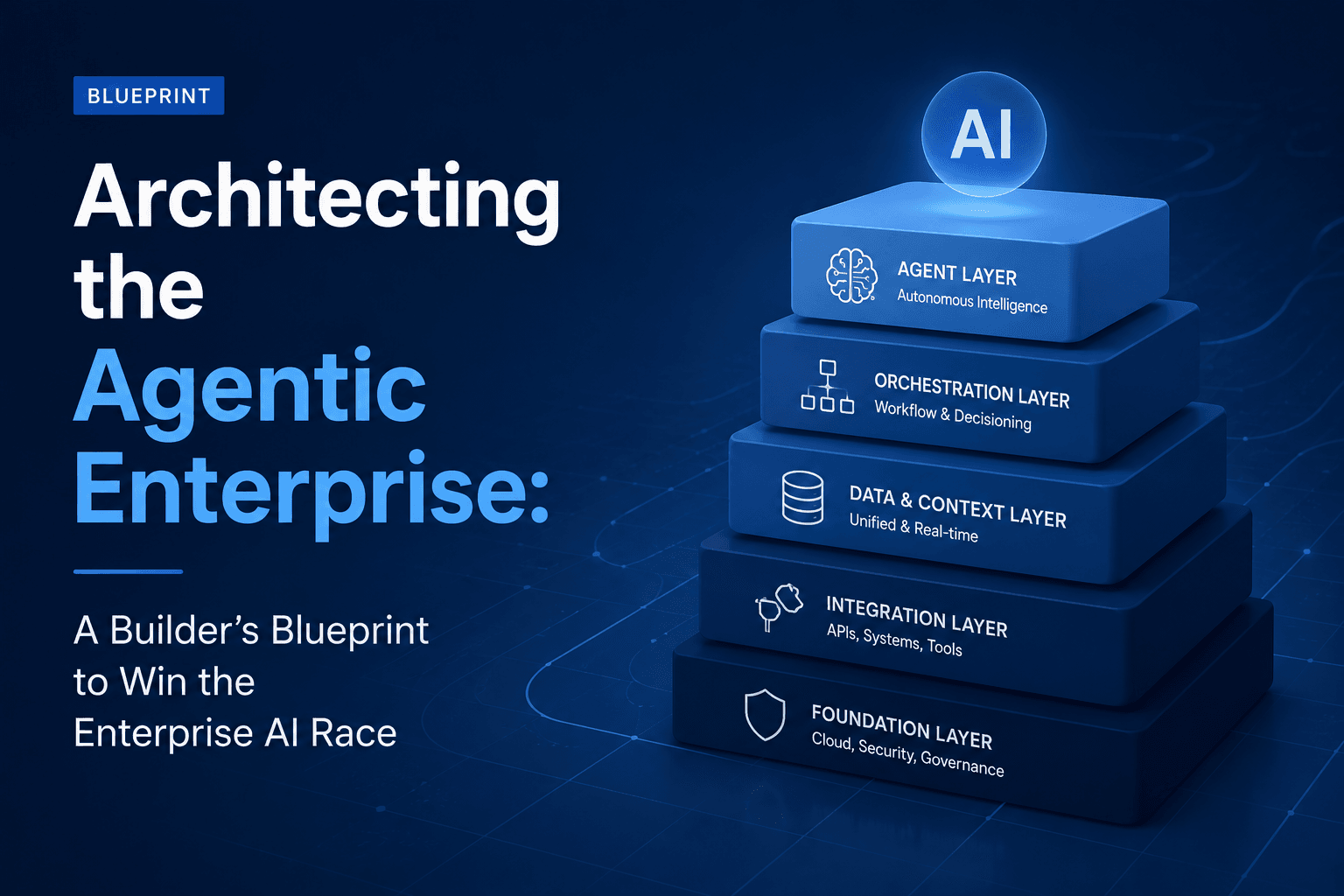
For years, legacy modernization has meant one thing: a development team manually rewriting old code, one function at a time, on a timeline measured in quarters. That is starting to change, not because generative AI writes better code snippets, but because agentic AI can now own entire steps of the migration process, analyzing legacy code, rewriting it, testing it, and validating it, with a human defining the strategy rather than typing every line.
This matters because generic GenAI coding assistance was never going to solve this problem on its own. Handing a developer AI generated code fragments speeds up small tasks but barely dents the actual effort of a full legacy migration, the work stays manual, slow, and expensive. Agentic AI closes that gap by taking ownership of the modernization steps themselves.
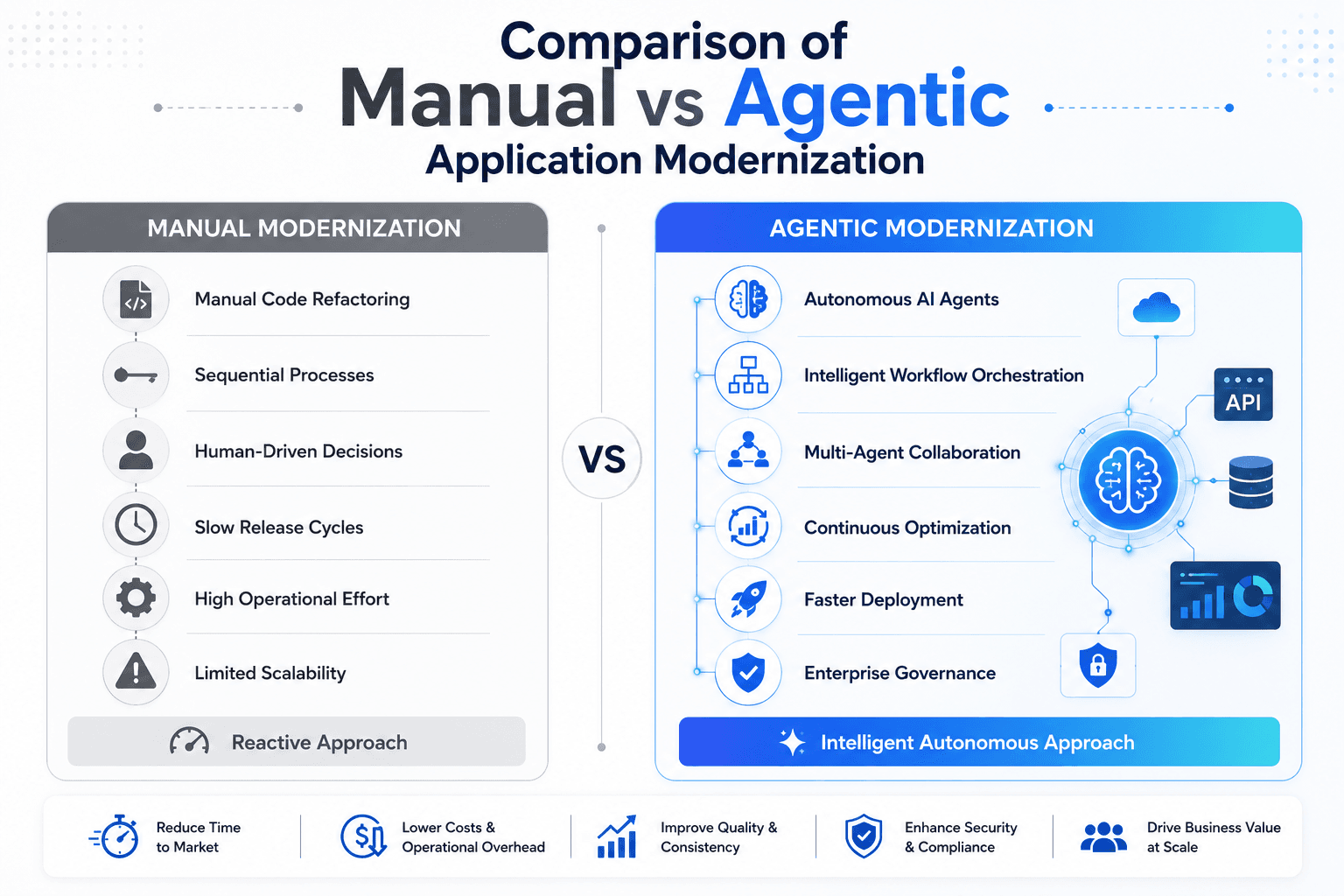
Comparison of Manual versus Agentic Application Modernization
Agentic AI Fundamentals
| Concept | What It Actually Means |
|---|---|
| What is agentic AI engineering | The discipline of designing autonomous AI agents that plan, act, and self correct toward a goal, rather than simply generating a response when prompted |
| AI agents vs LLMs for coding | An LLM generates code when asked; an AI agent decides what code needs to change, makes the change, tests it, and iterates based on the result, without a human prompting each step |
| Autonomous AI software engineers | Agents that take ownership of a development task end to end, analyzing existing code, writing new code, and validating it against defined criteria |
| Multi agent systems for legacy code | Specialized agents (each handling analysis, rewriting, testing, or deployment) coordinating through a shared orchestration layer to complete a migration collaboratively |
| Agentic workflows for app updates | A structured sequence where agents hand work to each other, a developer agent output becomes a QA agent input, mirroring how a human engineering team actually works |
How Agentic AI Actually Modernizes Legacy Code
The clearest real world example of this comes from Capgemini published account of their multi agent modernization tool. Rather than one generalist AI doing everything, the system mirrors the structure of a human development team, each agent has a specific role:
- A developer agent analyzes the existing source code and rewrites it in the target technology stack.
- A QA or testing agent validates the rewritten code against predefined test cases, and sends detailed error feedback back to the developer agent when something fails.
- A DevOps agent builds the complete application once tests pass and checks it for runtime issues before it is considered done.
A human orchestrator still defines the overall migration strategy, providing the structured instructions that transfer institutional knowledge about the legacy system and the target architecture to the agents. The agents do not replace that judgment, they execute against it at a speed and consistency a manual process cannot match.
Multi Agent Modernization Architecture
Below is a visualization of how these autonomous agents coordinate under human guidance to automate the modernization lifecycle:
graph TD
    Human["Human Orchestrator (Strategy & Governance)"] -->|Defines Target Architecture & Rules| Dev["Developer Agent (Code translation & refactoring)"]
    Dev -->|Outputs rewritten code| QA["QA Testing Agent (Functional validation)"]
    QA -->|Error feedback on failure| Dev
    QA -->|Verified code on pass| DevOps["DevOps Agent (Build & Runtime checks)"]
    DevOps -->|Final deployment packages| Production["Production Registry"]
    style Human fill:#2563eb,stroke:#3b82f6,stroke-width:2px,color:#fff
    style Dev fill:#7c3aed,stroke:#8b5cf6,stroke-width:2px,color:#fff
    style QA fill:#db2777,stroke:#ec4899,stroke-width:2px,color:#fff
    style DevOps fill:#059669,stroke:#10b981,stroke-width:2px,color:#fff
    style Production fill:#d97706,stroke:#f59e0b,stroke-width:2px,color:#fff
Legacy Application Modernization: Where Agentic AI Applies
| Focus Area | How Agentic AI Changes the Approach |
|---|---|
| Modernizing legacy software with AI | Agents take on the repetitive core of rewriting and validating code, while human engineers focus on architecture decisions and edge cases |
| Legacy code refactoring tools | Agent assisted refactoring can process code at a scale a manual review cycle cannot match, while still flagging ambiguous logic for human review |
| Technical debt reduction AI | Agents prioritize debt sitting directly in the path of active modernization work, rather than attempting to resolve an entire codebase debt in one pass |
| Monolith to microservices AI migration | Agents help decompose monolithic logic into service boundaries by analyzing actual code dependencies, rather than relying on documentation that is often outdated |
| Automated code translation | A developer agent rewrites functions from the original language or framework into the target stack, with a QA agent validating functional equivalence before sign off |
Research from Microsoft highlights that agentic coding pipelines, combining semantic search with verification loops, can achieve up to a 90% accuracy rate in complex code translation tasks. Similarly, IBM reports that using AI driven code analysis reduces legacy mainframe migration discovery phases by up to 50%, significantly accelerating target cloud native modernization.
Technical Implementation
| Capability | What It Involves |
|---|---|
| AI driven code analysis | Agents parse the existing codebase to map dependencies, dead code, and business logic before any rewriting begins |
| Automated documentation for old code | Agents generate documentation for legacy systems that were never properly documented in the first place, based on what the code actually does rather than outdated specs |
| Agentic AI for unit test generation | A QA agent can generate test cases directly from the original application behavior, giving the migration a regression safety net that often did not exist before |
| AI patterns for legacy migration | Common patterns include the anti corruption layer (isolating legacy systems during transition) and the strangler pattern (incrementally replacing legacy components without a full cutover) |
| Automated API wrapping for old apps | Agents can generate governed API layers around legacy systems, making them consumable by modern applications without requiring the legacy core to be touched directly |
AWS and Google Cloud both emphasize that deploying containerized microservices through automated DevOps agents ensures consistent policy enforcement, automated compliance scanning, and secure runtime isolation during legacy code cutovers.
Real Case Study: Modernizing 40 Applications at Once
A German public sector organization needed to modernize approximately 40 outdated applications that could no longer be developed further, while also integrating new features and moving to a modern technology platform. Migrating all of them manually would have been slow and expensive at that scale. Using Capgemini multi agent modernization tool, a large share of the migration work was automated, reducing the development effort required and lowering project costs enough to free the client to focus on building new features instead of just keeping the lights on. The system runs in both public cloud and air gapped on premise environments, addressing data sovereignty requirements relevant to public sector and regulated clients.
Business Impact and ROI
| Metric | What the Data Shows |
|---|---|
| Cost of AI legacy modernization | Varies by codebase size and complexity, but the labor intensive core of manual rewriting and testing is exactly the work agentic AI automates, directly reducing the largest cost driver |
| Reducing risk in software updates | Automated test generation and QA agent validation catch regressions before deployment, reducing the risk profile compared to manual migration with limited test coverage |
| Time to market for modernized apps | Incremental, agent assisted modernization consistently outpaces full manual rewrites, which is also why incremental approaches show payback in 6 to 18 months versus 18 to 48 months for full rewrites, according to a 2025 BayOne analysis |
| AI engineering productivity gains | Concentrated in the repetitive, high volume steps, code analysis, rewriting, and test validation, rather than in architecture and design decisions, which remain human led |
| Legacy system maintenance costs | Continue compounding the longer modernization is deferred, since institutional knowledge erodes and compatibility with modern platforms narrows every additional year a legacy system stays in place |
According to Gartner, by 2028, autonomous AI agents will generate and manage over 20% of enterprise software patch releases. However, Gartner broader warning about agentic AI is also relevant context: over 40% of agentic AI projects are predicted to be canceled by the end of 2027, and legacy integration complexity is a named driver of that failure rate. Applying agentic AI specifically to the legacy modernization problem, rather than bolting it onto unmodernized infrastructure, is the more defensible use case of the two.
Comparative Analysis
| Comparison | What Actually Differs |
|---|---|
| Manual vs agentic modernization | Manual modernization scales linearly with developer hours; agentic modernization scales with orchestration quality, letting multiple migration steps run in parallel under human defined strategy |
| AI agents vs traditional RPA | RPA follows fixed, rule based steps and breaks when conditions change; AI agents reason about the task, adapt to unexpected code patterns, and self correct based on test failures |
| Best AI tools for legacy code | Depends on the target stack and migration pattern, but effective tooling combines a code analysis layer, an LLM orchestration framework (such as LangChain or LangGraph), and a dedicated testing and validation agent, not a single generic coding assistant |
| Agentic AI vs copilot for refactoring | A copilot suggests code changes a developer reviews and accepts line by line; an agentic system takes ownership of the refactor, tests it, and iterates without needing a human in the loop for every change |
| Enterprise AI migration frameworks | The strongest frameworks pair a human defined migration strategy with role specialized agents (developer, QA, DevOps), rather than a single generalist agent attempting the entire migration alone |
Frequently Asked Questions
What is agentic AI engineering in the context of legacy modernization?
It is the practice of using autonomous AI agents, each with a specific role like code analysis, rewriting, testing, or deployment, to take ownership of migration tasks that would otherwise require a human developer to complete manually, coordinated under a human defined migration strategy.
How is this different from just using GitHub Copilot or a similar coding assistant?
A coding assistant suggests code that a developer reviews and accepts. An agentic system takes ownership of the task, rewrites the code, runs it against test cases, and iterates on failures without waiting for a human to approve each individual step.
Can agentic AI actually replace a development team for legacy modernization?
No. A human orchestrator still defines the migration strategy and provides the deep expertise about the legacy system and target architecture. Agents execute against that strategy at scale and speed, but the architectural judgment remains human led.
What kinds of legacy systems is this approach best suited for?
Custom built applications on outdated technology stacks that need to move to modern platforms are the clearest fit, particularly where the volume of applications (dozens, not one or two) makes manual migration prohibitively slow and expensive.
How does agentic AI reduce risk in a legacy migration compared to manual rewriting?
Automated test generation gives the migration a regression safety net that legacy systems often never had in the first place, and a dedicated QA agent validates every change against defined test cases before it is considered complete, catching issues before deployment rather than after.
Does this approach work for regulated industries or public sector organizations with data sovereignty requirements?
Yes, provided the tooling is architected for it. Capgemini own implementation, for example, runs both in public cloud and air gapped on premise environments specifically to address sovereignty requirements relevant to government and regulated clients.
What's the difference between agentic AI and traditional RPA for this use case?
RPA follows fixed, rule based scripts that break when the underlying system changes. Agentic AI reasons about the actual code and test results, adapting its approach when something does not work as expected, which matters enormously in legacy codebases full of undocumented edge cases.
How long does an agentic AI assisted modernization typically take compared to a manual one?
It varies by scope, but incremental, agent assisted approaches consistently outperform full manual rewrites on time to value, mirroring the broader pattern where incremental modernization shows payback in 6 to 18 months versus 18 to 48 months for full rewrites.
What role does testing play in an agentic modernization pipeline?
A central one. The QA agent does not just check a box, it validates functional equivalence against the original system behavior and returns specific, actionable errors to the developer agent when something fails, creating a genuine feedback loop rather than a one way handoff.
Is agentic AI modernization only useful for large scale migrations (dozens of apps), or does it work for a single legacy system too?
It applies to both, but the economics favor scale. A single legacy application can still benefit from agent assisted analysis, rewriting, and testing, but the case for building or adopting a multi agent modernization pipeline strengthens considerably when there are many applications to migrate using the same approach.
Conclusion
The shift from generic GenAI code suggestions to genuine agentic AI engineering is what finally makes legacy modernization tractable at scale. Where a coding assistant marginally speeds up a manual process, a multi agent system, with specialized developer, QA, and DevOps agents working under a human defined strategy, takes ownership of the repetitive core of migration itself: analyzing old code, rewriting it, testing it, and validating it before deployment. Real deployments, including Capgemini own public sector case involving roughly 40 legacy applications, show this is not a theoretical benefit, it is a genuine reduction in both the time and cost of work that used to be measured in developer quarters. The organizations getting real value from this approach are the ones treating agentic AI as a way to execute a well defined modernization strategy faster, not as a replacement for having that strategy in the first place.
As enterprises continue balancing modernization costs, technical debt, and AI adoption, agentic AI engineering is emerging as a practical way to accelerate transformation without sacrificing governance or architectural oversight. Organizations that combine human expertise with specialized AI agents are likely to modernize faster while reducing operational risk.
This connects directly to two related questions worth exploring: why modernization has to happen before AI, not alongside it, and what agentic AI engineering actually involves as a broader discipline beyond legacy code specifically.
Junkies Coder engineers agentic AI systems for legacy modernization, pairing a human defined migration strategy with specialized agents for analysis, rewriting, and testing. Explore our legacy modernization services or our agentic AI engineering services to learn more.